
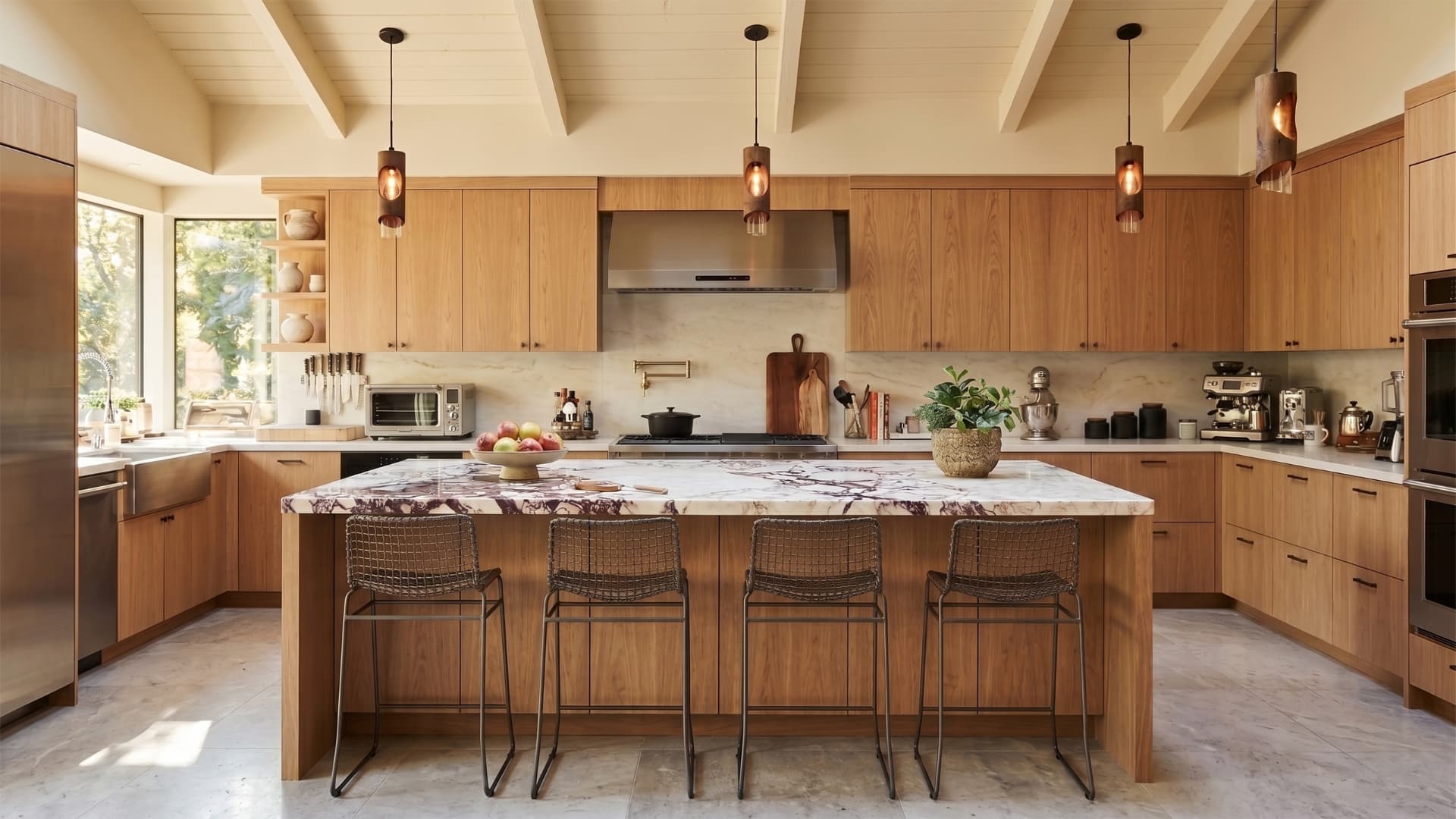
A kitchen island is often the most visible surface in the room. It sits at the center of the layout, gathers people around it, and carries much of the kitchen's visual weight. When that island is made with Italian marble, the slab does more than provide a working surface. It becomes a design feature.
The right Italian marble kitchen island can bring movement, scale, contrast, and refinement into a space. It can make a simple kitchen feel more layered, give a traditional kitchen a stronger focal point, or bring softness into a modern layout.
This is why the island should not be treated as an afterthought. It is often the place where the most expressive slab can be used with intention.
1. The Island Carries the Strongest Visual Impact
Unlike perimeter countertops, island countertops are usually open on multiple sides. This makes the stone more visible from different angles. A slab that may feel too expressive for a full kitchen perimeter can feel perfectly placed on an island because the surface has room to stand on its own.
Italian marble works especially well in this role because of its natural variation. Some slabs bring quiet movement. Others bring dramatic contrast. The island gives that movement a clear stage.
A marble island can influence how the entire kitchen feels:
- Softer white marble can make the space feel bright and calm.
- Warmer marble can make the kitchen feel more inviting.
- Grey veining can add structure and refinement.
- Dramatic veining can create a bold architectural statement.
2. Slab Movement Should Guide the Layout
When choosing marble for an island, the direction of the veining matters. Some slabs move horizontally. Others have diagonal movement, strong vertical shifts, or cloud-like patterning. The layout should respect that natural movement.
For longer islands, a slab with directional veining can help stretch the visual line of the kitchen. For shorter or more compact islands, a controlled pattern may feel more balanced.
Before finalizing a stone, it helps to consider:
- Which side of the island will be seen first?
- Will the veining run lengthwise or across the surface?
- Will the slab continue down a waterfall edge?
- Will the island include seating?
- Will a sink or cooktop interrupt the surface?
These decisions affect how the marble is experienced in the finished room.
3. Waterfall Edges Can Create Continuity
A waterfall island allows the marble to continue from the countertop down one or both sides of the island. This can make the stone feel more sculptural and architectural.
With Italian marble, a waterfall edge works best when the veining is considered carefully. If the pattern flows naturally from the top surface down the side, the result can feel seamless and intentional. If the movement is interrupted, the effect may feel less refined.
A waterfall edge is not required for every luxury kitchen, but it can be powerful when the stone has enough movement to support it.
4. Seating Changes the Design Experience
Many kitchen islands also function as gathering spaces. When seating is included, the marble becomes part of how people experience the kitchen up close.
This matters because the island is not viewed only from across the room. It is touched, used, and seen up close. The surface should feel balanced from both a design and a practical perspective.
For islands with seating, consider:
- Overhang placement
- Edge profile
- Slab thickness
- Legroom
- Lighting above the seating area
- Visibility of veining from seated positions
A beautiful slab should also support the way the kitchen will be used every day.
5. The Surrounding Materials Should Support the Stone
An Italian marble kitchen island is strongest when the surrounding materials give it enough space to lead. Cabinetry, flooring, lighting, and hardware should support the stone rather than compete with it.
For dramatic marble, simpler cabinetry can create balance. For quieter marble, richer wood tones or warm metals can add depth. For white marble, lighting can help reveal subtle veining and texture.
For broader kitchen island inspiration, Architectural Digest offers a gallery of ideas that highlights how islands can act as the room's anchor: Architectural Digest Kitchen Island Ideas.
6. The Right Slab Begins with Scale
The best Italian marble kitchen island is not always the boldest slab in the showroom. It is the slab that works with the island's size, the kitchen's layout, and the home's mood.
A large island may require strong movement to prevent the surface from feeling empty, while a smaller island might benefit from a more controlled pattern. In a kitchen with detailed cabinetry, restraint can be valuable, whereas a minimal kitchen could be enhanced by a more expressive stone. Ultimately, the best choice should feel natural within the overall design.
Related main article placeholder: [Italian Marble Countertops in Atlanta: Natural Stone for Refined Kitchen Design]
Explore Italian Marble Kitchen Islands with Bottega Surfaces
Bottega Surfaces offers curated Italian marble, quartzite, limestone, granite, and specialty natural stone for refined kitchen projects. Whether the goal is a quiet marble island, a dramatic slab centerpiece, or a carefully balanced kitchen surface, the selection begins with seeing the material in person.
Schedule a Showroom Visit, Book an Online Inquiry, or View Stock to explore available natural stone selections.